BabySteps: AR Storytelling for Prenatal Bonding
This project was developed as part of an experience-based learning opportunity in collaboration with Tandem Impact Collective.
An AR mobile app that transforms the 40-week pregnancy journey into an immersive, emotionally resonant experience, using a living Night Sky as its narrative framework.
Overview
BabySteps is an AR mobile application built for Tandem Impact Collective, developed as the MDM capstone project by Team Panoruk. It transforms the 40-week pregnancy into an immersive storytelling experience using a living Night Sky metaphor — evolving from deep night in Week 1 to sunrise at birth.
Existing prenatal tools focus on information delivery: weekly stats, checklists, and clinical diagrams. BabySteps addresses a different need entirely. It prioritizes emotional accompaniment over information, ritual over task completion, and shared participation over solitary use — building genuine prenatal bonding for both gestational parents and their partners.
As Project Manager, I owned the product vision, client relationship, scope definition, sprint planning, user research, and final handoff across the full 12-week lifecycle.
Goal
BabySteps had three core product goals:
1. Make prenatal development emotionally tangible. Transform biological milestones into narrative moments of personal discovery — attracting through curiosity, sustaining through genuine emotional resonance.
2. Design for low-pressure, self-directed engagement. Allow parents to return at their own pace: no streaks, no reminders, no pressure. Accessible across all emotional states and all 40 weeks.
3. Deliver a personalized shared experience. The Night Sky evolves in response to actual developmental milestones. The partner module creates real shared moments. The journal captures memories that are uniquely theirs.
Role & Responsibilities
As the sole Project Manager on Team Panoruk, I owned the product direction across the full lifecycle, from discovery through client handoff.
Discovery & Research
Led user interviews and competitive research to identify the core gap: parents needed emotional accompaniment, not more information. Synthesized findings into 3 core design principles: low-pressure engagement, shared participation, and personalized milestones.
Concept Direction & Decision-Making
Facilitated evaluation of 3 concept directions. Drove the decision to merge the top two — resulting in the Night Sky concept combining AR immersion with personal memory-keeping. Responded to client input mid-process to make partner engagement a core feature, not an add-on.
Scope & Prioritization
Defined a 10-feature priority stack separating MVP core from future iterations. Explicitly scoped out 6 features — medical monitoring, social sharing, user login, 3D animation rigging — to protect delivery within 12 weeks.
Agile Execution
Ran 6 sprints across 2 phases. Facilitated bi-weekly sprint reviews aligned to client meeting cadence. Coordinated across design, development, and art asset production tracks simultaneously.
User Testing & Iteration
Planned and ran 2 rounds of playtesting — 42 internal participants in Week 6 and 65 external participants at DigiBC Signals Studio in Week 9. Validated emotional resonance and interaction usability. Translated findings into concrete design changes each round.
Client & Stakeholder Management
Primary point of contact with Tandem Impact Collective throughout. Prepared and presented concept proposals, sprint outcomes, and milestone updates. Managed final handoff including GitHub repo, iOS/Android builds, and full documentation package.
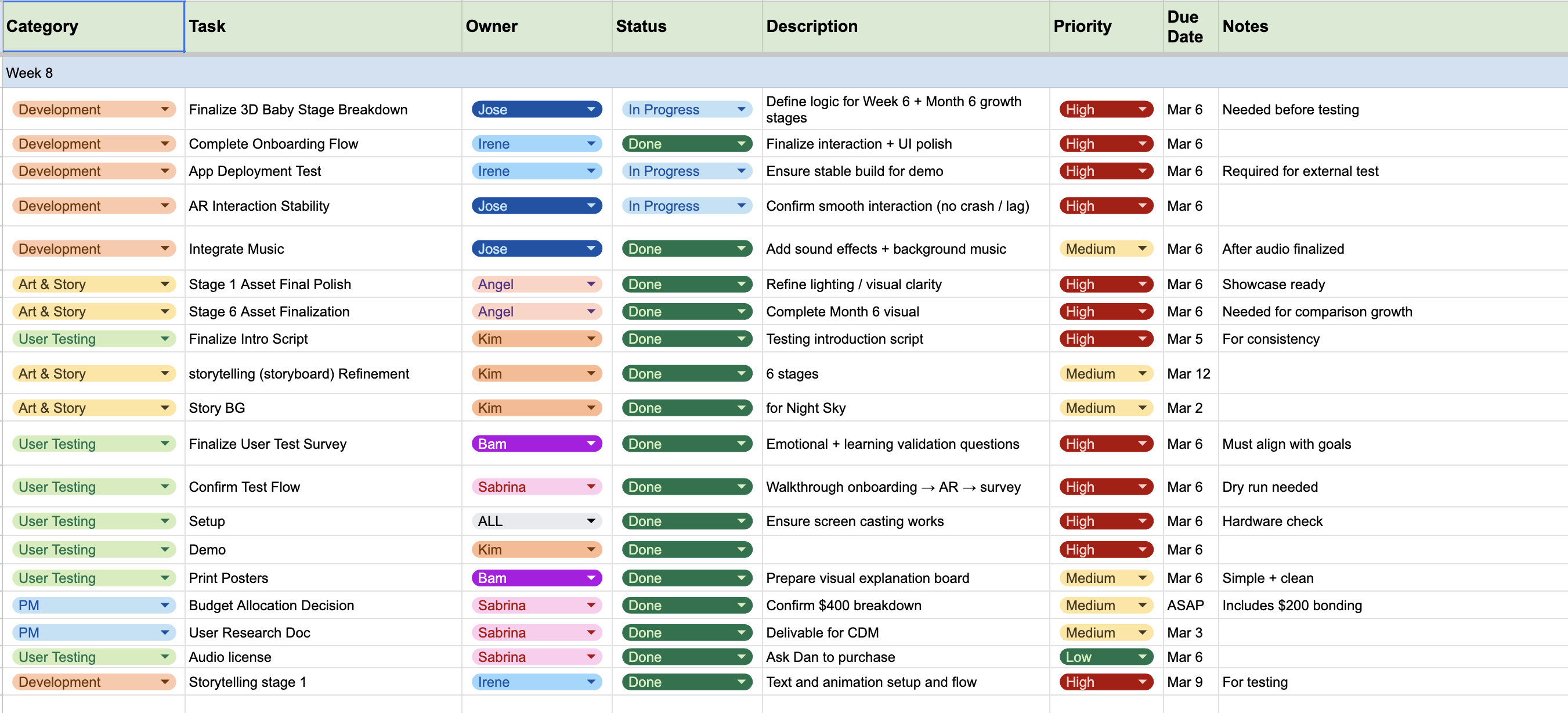
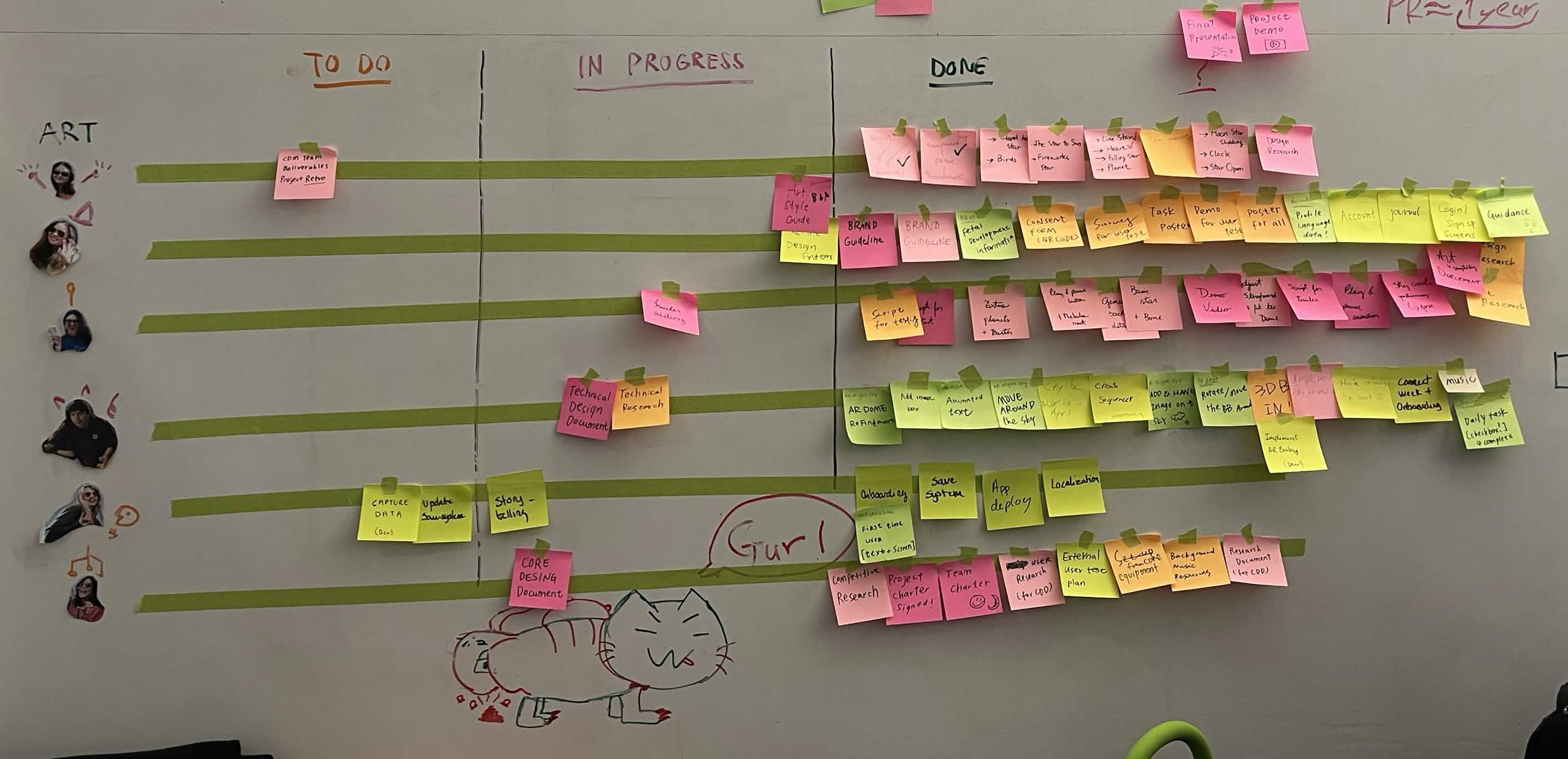
Development Timeline
SPRINT 1
Research & Ideation
Weeks 1–2 · Jan 6–16
- User interviews and competitive analysis
- Emotional journey mapping · Explored 3 concepts: Night Sky Scrapbook, Bookcase
- Team Charter and emotional pillars locked
SPRINT 1
Research & Ideation
Weeks 1–2 · Jan 6–16
- User interviews and competitive analysis
- Emotional journey mapping · Explored 3 concepts: Night Sky Scrapbook, Bookcase
- Team Charter and emotional pillars locked
SPRINT 2
Prototyping & AR Exploration
Weeks 2–4 · Jan 19–20
- Night Sky concept selected, merged with Scrapbook
- Scope defined: 6-stage pregnancy arc
- Technical feasibility checks (ARKit, ARCore)
- Feature priority stack defined — 10 features ranked
- Project Charter drafted and signed by client
SPRINT 2
Prototyping & AR Exploration
Weeks 2–4 · Jan 19–20
- Night Sky concept selected, merged with Scrapbook
- Scope defined: 6-stage pregnancy arc
- Technical feasibility checks (ARKit, ARCore)
- Feature priority stack defined — 10 features ranked
- Project Charter drafted and signed by client
SPRINT 3
MVP & First Playtest
Weeks 5–8 · Feb 5–13
- Lo-fi AR experience flow designed
- Sample stage mock-ups built in Figma
- Internal user test: 42 participants
- Findings: AR dome too high, copy confusing
- 5 design changes shipped after testing
SPRINT 3
MVP & First Playtest
Weeks 5–8 · Feb 5–13
- Lo-fi AR experience flow designed
- Sample stage mock-ups built in Figma
- Internal user test: 42 participants
- Findings: AR dome too high, copy confusing
- 5 design changes shipped after testing
SPRINT 4
Iteration & Journey Feature
Weeks 7–8 · Jan 23–Mar 6
- All Round 1 test findings integrated
- AR dome height lowered, 180° interaction range
- Journal navigation redesigned
- Night Sky art assets applied for Stages 1–2
- Partner View defined as mandatory feature
SPRINT 4
Iteration & Journey Feature
Weeks 7–8 · Jan 23–Mar 6
- All Round 1 test findings integrated
- AR dome height lowered, 180° interaction range
- Journal navigation redesigned
- Night Sky art assets applied for Stages 1–2
- Partner View defined as mandatory feature
SPRINT 5
Integration & Second Playtest
Weeks 9–10 · Mar 9–20
- Stages 1–2 fully implemented in live AR prototype
- External test: 65 participants at DigiBC Signals
- Findings: 3/3 mood fail — clinics, metaphor unclear, onboarding
- 6 changes: warm rendering, organ toggle, onboarding
- Stages 3–4 AR build started
SPRINT 5
Integration & Second Playtest
Weeks 9–10 · Mar 9–20
- Stages 1–2 fully implemented in live AR prototype
- External test: 65 participants at DigiBC Signals
- Findings: 3/3 mood fail — clinics, metaphor unclear, onboarding
- 6 changes: warm rendering, organ toggle, onboarding
- Stages 3–4 AR build started
SPRINT 6
Polish & Handoff
Weeks 11–12 · Mar 23–Apr 3
- Dawn and Sunrise transitions completed
- Full 6-stage emotional arc shipped
- Delivered: iOS/Android builds, docs
- Client review meeting April 1 · full sign-off
- Final handoff to Tandem Impact Collective complete
SPRINT 6
Polish & Handoff
Weeks 11–12 · Mar 23–Apr 3
- Dawn and Sunrise transitions completed
- Full 6-stage emotional arc shipped
- Delivered: iOS/Android builds, docs
- Client review meeting April 1 · full sign-off
- Final handoff to Tandem Impact Collective complete
Process & Solution
Concept Decision: The Night Sky Merge
After user interviews and secondary research, we explored three distinct concept directions. No single approach was sufficient on its own. The Constellation direction had the strongest potential for emotional resonance and AR immersion. The Scrapbook offered the richest personal memory layer. I drove the decision to merge both into the Night Sky concept — a unified direction combining symbolic storytelling, developmental visualization, and personal ritual in a single coherent AR environment.
Partner-First Product Constraint Mid-process, the client expressed that AR technology and partner engagement must be core features rather than add-ons. I translated this into a product rule: every primary feature must include a Partner View or shared engagement mode. This shaped the entire feature design from Sprint 3 onward.
Scope Protection
With a 6-person team and 12-week timeline, I defined a strict 10-feature priority stack. Core features (Weeks 1–6): AR Night Sky, 3D Baby Visualization, 6-stage storytelling, daily task system. Supporting features (future iterations): multi-language support, journal image entries, partner notifications, account management. Six features were explicitly scoped out to protect delivery quality.
User Testing Loop
Round 1 (42 internal participants, Week 6): Identified AR dome height issues, abstract onboarding copy, and insufficient 3D model warmth. Shipped 5 design changes before external testing.
Round 2 (65 external participants, Week 9, DigiBC Signals Studio): Identified 3D model perceived as too clinical, Night Sky metaphor unclear on first encounter, and navigation confusion. Shipped 6 design changes including warm rendering, organ toggle, onboarding rewrite, pinch-to-zoom, storytelling cues, and dome repositioning.
Client Testimonial
- —Thanks again to everyone for all your hard work this semester! The product turned out great! - Tandem Impact Collective, Dan Block
Observations
60% of external users felt Curious during the AR experience.
50.8% felt Calm, directly validating the low-pressure design principle.
49.2% rated the Night Sky storytelling animation as the most engaging interaction.
88.1% described background music as calming- direction confirmed and carried forward.
3.6 out of 5 average emotional engagement score across 65 external participants.
6 concrete design changes shipped after each testing round.